Australia Cold Snap: Warning Signs, Safety Tips & Power Prep [2026 Guide]
- Quick Answer: What Is a Cold Snap in Australia?
- What Causes Cold Snaps in Australia?
- Australia Cold Snap Today: Where Should You Check Warnings?
- Which Parts of Australia Are Most Often Affected by Cold Snaps?
- Australia Cold Snap Preparation Checklist
- What to Do If the Power Goes Out During a Cold Snap
- Conclusion
- FAQs
A cold snap in Australia can quickly turn from a weather headline into a household concern, bringing frosty mornings, biting winds, snow at higher elevations and disruption to travel or power supply. The temperature alone does not tell you how the event may affect your home, family, pets or essential devices. This guide explains what causes cold snaps, where to check warnings, and how to prepare before temperatures drop.
Quick Answer: What Is a Cold Snap in Australia?
Cold weather in Australia varies widely by region, but a cold snap refers to a short burst of unusually low temperatures that often arrives suddenly and may bring frost, snow, or icy winds.
For a household, that can mean more than a lower number on the forecast. A cold snap can affect:
Morning frost and icy roads.
Snow in alpine or elevated areas.
Strong, gusty winds.
Higher heating demand.
Outdoor work, pets, and vulnerable people.
Travel delays or hazardous driving.
Power reliability during storms, high winds, or weather-related faults.
What Causes Cold Snaps in Australia?
Cold snaps in Australia usually begin with a change in air mass. Warm or mild air is replaced by colder air, often pushed north from the Southern Ocean. When that shift is strong enough, temperatures can drop quickly, winds can turn colder, and southern or elevated regions may see frost, hail, or snow.
The important part is the movement. A cold snap is not simply "winter being cold." It is a short, sudden departure from the conditions normally expected for the time of year.
.PNG)
Cold Air Moving North from the Southern Ocean
Australia sits close enough to the Southern Ocean for cold air outbreaks to affect the country, particularly across southern Australia. When the weather pattern pulls that cold air north, the change can be felt across southern states and sometimes further inland or east depending on the system.
This is why cold snap headlines often mention South Australia, Victoria, Tasmania, New South Wales, the ACT, alpine regions, and parts of Western Australia. The exact impact depends on the path of the front, cloud cover, rainfall, wind direction, and overnight conditions.
Cold Fronts and Sudden Temperature Drops
A cold front is the boundary where colder air pushes into warmer air. BOM explains that cold fronts are common in southern Australia and often have their greatest impact in winter. A strong front can bring cooler temperatures, rain, hail, thunder, lightning, and gusty winds.
That is why a cold snap can feel abrupt. The day before may be mild. Then the front moves through, the wind shifts, clouds and showers arrive, and the air behind the change is much colder. If the air is cold enough and there is enough moisture, snow can fall in alpine areas or occasionally to lower levels.
Frost, Snow, and Overnight Conditions
Cold snaps are not only about daytime temperature. Overnight conditions often matter more for frost, roads, gardens, livestock, and outdoor equipment. If skies clear at night, heat can escape quickly from the ground. That can increase the chance of frost, especially in inland, valley, or exposed areas.
Frost is easy to underestimate because the danger can be local. In frost-prone districts, a road may appear wet while shaded sections, bridges, or low-lying areas develop black ice. For drivers, walkers, early commuters, and people working outdoors, the morning after the front may bring the greatest local frost and road risk.
Australia Cold Snap Today: Where Should You Check Warnings?
Weather changes quickly during a cold snap. A national news story can be useful for context, but it cannot replace a local forecast. Your suburb may miss the worst of the system while a nearby inland town, exposed coast, or elevated road experiences stronger winds, frost, or snow.
Start with the Bureau of Meteorology
The Bureau of Meteorology should be the first stop for:
Local forecasts and observations
Current weather warnings
Rain radar
Frost and snow forecasts where relevant
Short-term forecast maps
If a cold front is moving through, check both the forecast and the warnings page. A forecast tells you what is expected. A warning tells you whether conditions may become hazardous.
Use Your State or Territory Emergency Sources
If a cold snap brings damaging winds, heavy rain, snow, or hazardous roads, check your state or territory emergency service for local instructions. You can also use ABC Emergency for a national overview and watch for Emergency Alert messages sent by authorities to affected areas.
Useful checks include:
Local emergency warnings.
Road closure and alpine road reports.
Electricity distributor outage maps.
Local council, school, or community notices.
Health advice for cold conditions.
Broad headlines about a polar blast, Antarctic blast, or approaching cold snap may describe the wider weather pattern, but they cannot show the conditions around your home or travel route. Use local warnings, road updates, and outage information when deciding whether to change your plans.
Which Parts of Australia Are Most Often Affected by Cold Snaps?
Cold snaps can affect different parts of Australia depending on the season and the weather pattern. The affected area changes with the path and strength of each system, although southern, alpine and inland regions appear more often because of their latitude, elevation and exposure to Southern Ocean air.
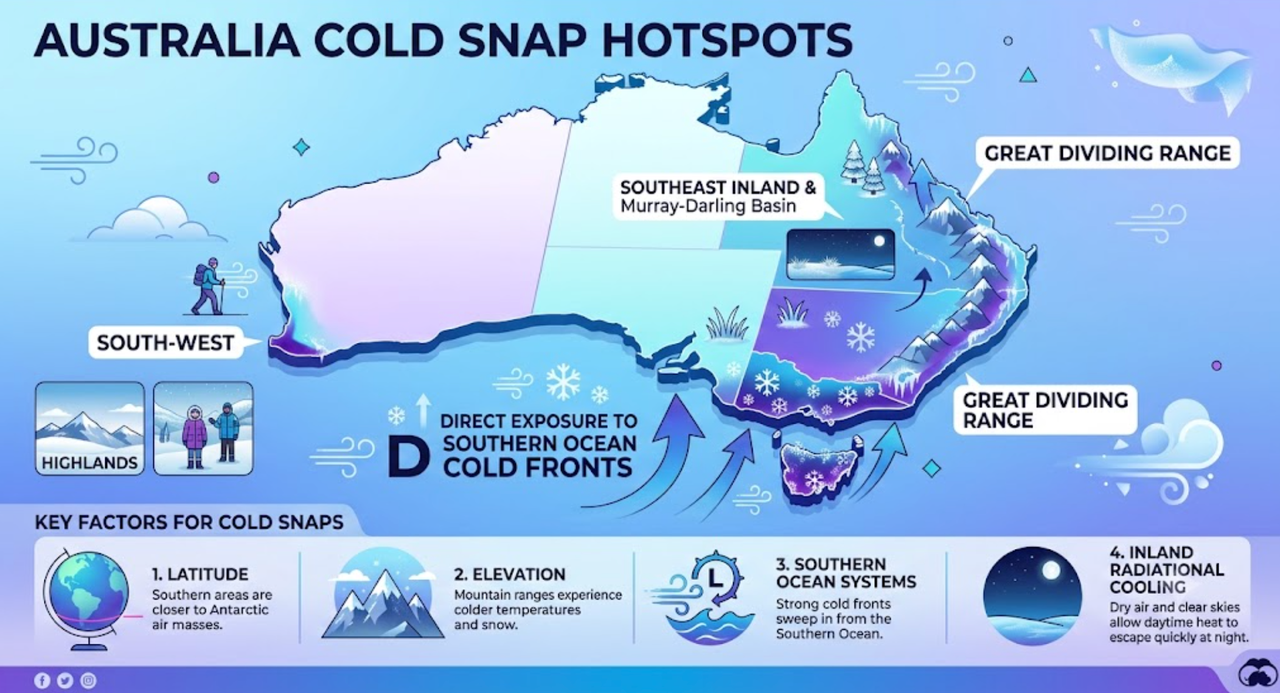
Victoria, South Australia and Tasmania
Cold snaps can bring sharp overnight temperature drops across inland Victoria and South Australia, where clear skies often increase the chance of morning frost. Tasmania faces colder conditions more frequently because of its southern location and exposure to Southern Ocean weather systems, with snow possible across higher ground during stronger outbreaks.
Frost can affect crops, gardens and early road travel, particularly in rural districts, valleys and elevated areas. Conditions may remain slippery on shaded roads and bridges even after temperatures begin to rise.
Western Australia
Western Australia can be the first part of the country to feel strong cold fronts moving from west to east across southern Australia. South-west WA can see wind, rain, storms, and a temperature change as a front passes.
Exposed coastal areas may experience stronger winds, while inland parts of the south-west can record colder overnight temperatures after the front passes.
Alpine and Inland Areas
Alpine areas across Victoria and New South Wales face the greatest snow, ice and road risks during a strong cold outbreak. The Snowy Mountains, Victorian Alps and nearby elevated districts may experience lower snow levels, reduced visibility and hazardous driving conditions.
The ACT, tablelands and inland parts of New South Wales, Victoria and South Australia can also become very cold overnight, especially when skies clear behind a front. Frost may be more severe in valleys, rural districts and other low-lying areas.
Australia Cold Snap Preparation Checklist
Use this checklist before the next strong cold front or winter cold snap in Australia:
Timing | What to Do |
2–3 days before | Test your heating, reduce draughts, prepare warm bedding, and check that torches and power banks are working. |
24 hours before | Secure loose outdoor items, prepare a warm space for pets, check medication, and fully charge phones and backup power. |
Morning of the coldest day | Check road and public transport updates, dress in layers, and adjust early travel plans in frost-prone areas. |
After conditions ease | Recharge devices, restock anything you used, and note any gaps in your heating, lighting, communication, or backup power plan. |
In cold-prone areas, make this checklist part of your regular winter preparation. Keep torches, charging cables, warm bedding, medication, and backup power equipment in known locations so your household can respond quickly when temperatures drop.
What to Do If the Power Goes Out During a Cold Snap
Take the First Safety Steps
If the power goes out, start by checking whether the outage affects only your home or the wider area, then look for updates from your electricity distributor.
Start with these steps:
Check your switchboard if it is safe to do so.
Look outside for obvious wider outage signs, such as neighbouring homes also losing power.
Check your distributor's outage page using mobile data if available.
Keep fridge and freezer doors closed, and check how long food can remain safe in the fridge during a prolonged power outage.
Use torches or battery lights instead of candles where possible.
Keep phones charged for alerts and calls.
If someone relies on a medical device, follow their emergency power plan and contact relevant support if needed.
During a cold snap, warmth matters, but safety comes first. Carbon monoxide risk is not worth taking. If your home becomes unsafe or too cold for vulnerable people, follow local emergency advice and consider moving to a safer location.
Prioritise Essential Loads
Start by identifying the devices you would need during the first few hours of an outage. Rather than asking, “Can I power the whole house?”, ask, “Which devices would matter most until the grid comes back?”
Essential loads are the devices that protect communication, safety, food, work, health, or basic comfort. The essential-load list is often shorter than expected. A router, LED light, phone, laptop, or medical device may be a higher priority than a large heater that drains battery capacity quickly.
Essential item | Why it matters | Planning note |
Phone | Emergency contact, alerts, maps, family updates | Keep charging cables together |
Router/modem | Communication, work, school, outage updates | Useful only if the internet service itself remains active |
LED lights | Safe movement at night | Low wattage makes them backup-friendly |
Fridge/freezer | Food preservation | Keep doors closed to reduce runtime demand |
Laptop | Work, study, communication | Usually easier to support than large appliances |
Radio | Information if mobile coverage or internet is limited | A battery radio is a simple backup |
Medical device | Health-critical support | Confirm wattage, runtime, and compatibility in advance |
Small cooking or warming device | Basic food preparation | Check wattage carefully; many heat-producing devices are demanding |
The load list should be specific. "Kitchen" is not a load. "Fridge", "kettle", "microwave", and "lights" are separate loads with very different power needs.
Once you know which devices need power first, you can choose a backup system that matches the size and expected duration of your essential-load plan. A portable power station offers a clean, versatile option to provide temporary electricity during an outage.
Because of its compact design, you can easily move the EcoFlow DELTA 3 Plus Portable Power Station around apartments, home offices, or smaller residences. It delivers enough output power to run daily electronics, while its fast UPS switching keeps devices running without interruption during grid failures.
The EcoFlow DELTA Pro 3 Portable Power Station supports larger demands, running high-draw appliances such as refrigerators and kitchen equipment. High output power and large built-in capacity give households solid backup, with expandable battery options for extended grid disruptions. During severe weather or an Australian winter cold snap, this extra capacity and output headroom ensure steady power for crucial household priorities.
Avoid Unsafe Heating and Power Choices
Cold conditions can encourage unsafe shortcuts that increase fire or carbon monoxide risks. Avoid these mistakes:
Never use outdoor generators, BBQs, charcoal burners, or fuel-burning camping stoves indoors or in enclosed garages.
Keep portable heaters away from curtains, bedding, clothing, and furniture, and do not connect them through overloaded power boards or extension leads.
Do not run several high-wattage appliances from the same outlet or backup power source.
Check appliance wattage and power station limits before connecting heaters, kettles, ovens, or other heat-producing devices.
Use heating appliances only as directed and keep backup power focused on loads the system can support safely.
Conclusion
An Australian cold snap brings frosty roads, severe wind chill, and potential power disruptions. Check local BOM warnings first to assess risks in your suburb. Then prepare your home systematically: keep family and pets warm, charge phones, organise safe lighting, avoid running generators indoors, and list the essential devices you need to power during an outage.
FAQs
Which Australian states are most affected by cold snaps?
Cold snaps are often reported across southern and south-eastern Australia, including Victoria, Tasmania, South Australia, southern New South Wales, the ACT, and alpine regions. Western Australia can also experience strong cold fronts, especially in the south-west. The exact affected area depends on the front, air mass, season, and local geography.
What should I power first during a winter outage?
Prioritise communication, safety, and health. Phones, a router if internet service remains active, LED lights, medical devices, a laptop, and fridge/freezer protection are usually more important than high-wattage comfort appliances. Heating appliances can draw a lot of power, so check wattage and runtime before relying on a power station for them.
What is the coldest month in Australia?
July is usually the coldest month across much of Australia, although the timing varies by region. Some parts of south-west Western Australia record their coldest conditions in early August, and the tropical north follows a different seasonal pattern. Check long-term climate averages for your nearest BOM weather station for a more accurate local comparison.